Smart bulbs (retrofit)
Fits: Any existing light fitting with a standard socket
Screw-in bulbs that connect to Wi-Fi and a voice assistant. Lowest-cost option — no wiring changes, no electrician needed for most fittings.
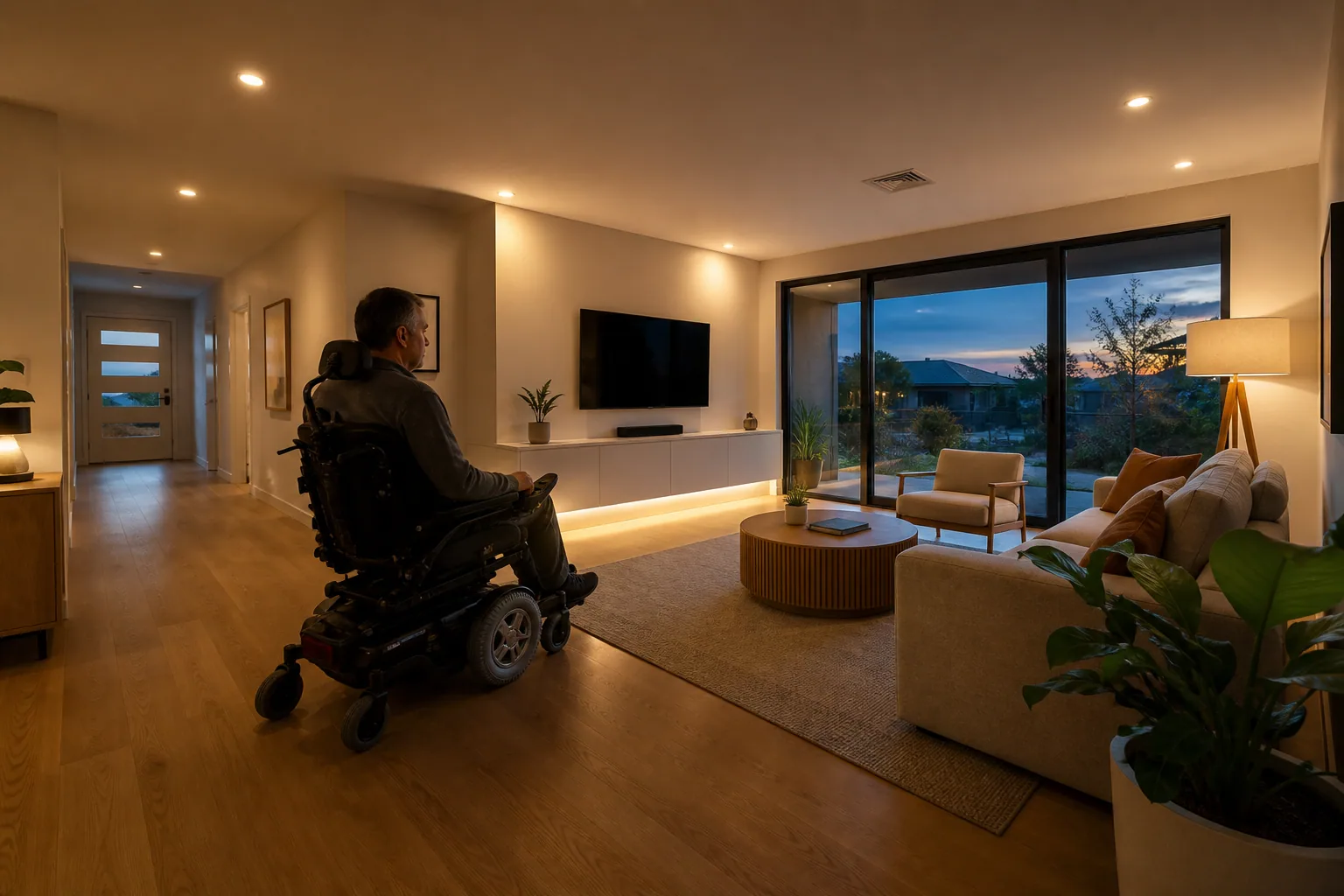
Voice, motion and app-controlled lighting for independence, safety and sensory needs. Retrofit bulbs, smart switches, motion sensors and circadian scenes for NDIS participants across Perth.
Wall switches assume you can see them, reach them and press them. Smart lighting drops all three assumptions and matches the way you actually move through your home.
Wall switches become impractical for many participants. Voice, motion or automated lighting removes the need to reach, press or twist.
Standard switch heights sit above shoulder line for most seated users. Automated lighting responds to your voice or presence, not the switch you can't reach.
Dimmable, colour-tunable lighting with soft transitions supports sensory regulation — no sudden bright switches, no flicker.
Voice-first control removes the need to find a switch or read a display. Bright, even lighting on demand supports safer movement at home.
Say the word — Alexa, Google Home or Apple HomeKit turns lights on, off, or to a set scene.
Lights come on as you enter a room and turn off after you leave. No switches, no memory tax.
Automatic morning brighten, evening dim, night-safe low-level pathway lighting.
Warm evenings, cool mornings, calm sensory scenes — the same fixture, different feel.
Adjust from bed, from your chair, from the other room — no need to be near the switch.
Depending on your plan and goals, smart lighting may sit under Assistive Technology or Home Modifications budgets.
We match hardware to how you actually use each room — most installations mix a few of the following.
Fits: Any existing light fitting with a standard socket
Screw-in bulbs that connect to Wi-Fi and a voice assistant. Lowest-cost option — no wiring changes, no electrician needed for most fittings.
Fits: Wall-switched lighting circuits, whole rooms at once
Replace the wall switch, not the bulbs. Controls the whole circuit and keeps the manual switch working for support workers and visitors.
Fits: Bathrooms, hallways, stairs, wardrobes
Passive infrared or radar sensors trigger lights automatically. Ideal for night-time safety without needing to find a switch.
Fits: Bedrooms, living rooms, sensory-safe spaces
Programmable colour and brightness scenes for sensory regulation, calming evenings or wake-up routines. Set once, run automatically.
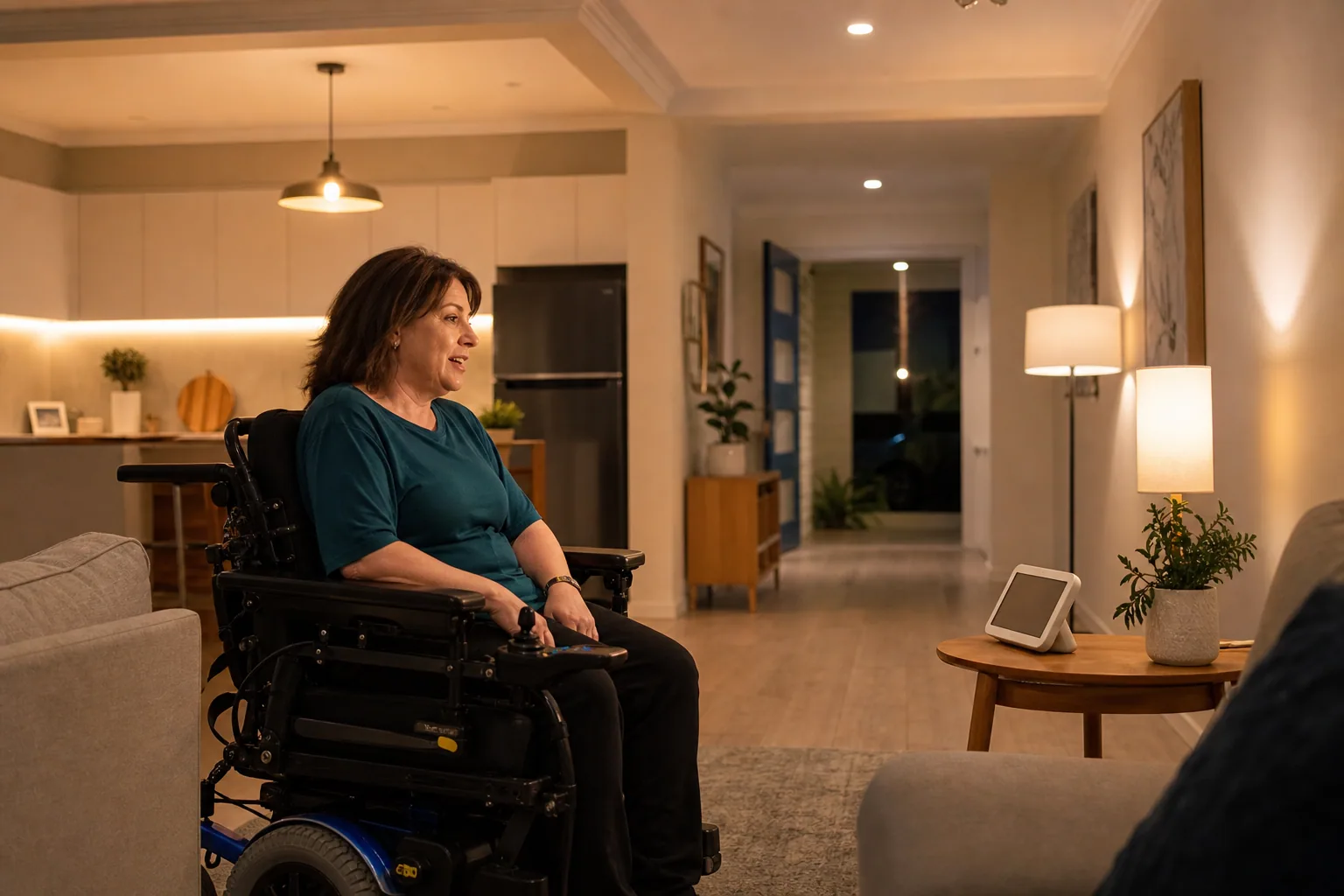
Warm evenings, calm mornings — one system, every scene.
We are not tied to one manufacturer. These are the systems we fit most across Perth, chosen because they hold up in a real home and keep working when the internet does not.

The system we fit most often — white-ambience downlights, colour bulbs, filament globes and light strips, all run from one Hue Bridge that stores scenes locally.

In-wall relays and dimmers that make an existing hard-wired circuit smart. Fittings stay as they are and the wall switch keeps working for support workers and visitors.

Presence sensors that read stillness as well as movement, so bathroom and hallway lighting stays on for someone standing still — not just someone walking past.

TRÅDFRI gateway and low-cost bulbs. A sensible starting point when you are extending one room at a time rather than doing the whole house at once.

Australian-designed smart ceiling fans and fittings that put light and airflow on a single voice command or evening routine.

Echo speakers and Show displays for voice-first control, with routines that group several lights into one short phrase.

Nest Mini and Nest Hub for households already using Google, including a touchscreen scene panel that needs no phone.

HomePod mini and Apple Home for participants in the Apple ecosystem, with Siri control from an iPhone, iPad or Apple Watch.
All product names, logos and brands are the property of their respective owners and are shown to identify the equipment we install. Innogreen is an independent installer, not an authorised reseller or agent for these companies. Ranges change — we recommend hardware against your assessment, not a fixed catalogue.
Most lighting quotes stop at bulbs. These are the details that decide whether a system gets used every day or quietly abandoned after a month.
A Tap Dial, dimmer switch or bedside remote gives support workers, family and visitors a button to press. Nobody should have to download an app to turn on a light in your home.
Path, carport and driveway sensors bring lighting up before you reach the door — the difference between arriving home safely and finding a keyhole in the dark.
Smart ceiling fans respond to the same routine as your lighting, so one phrase handles both comfort and visibility on a hot Perth evening.
Relays hidden behind the switch plate suit heritage, pendant and architectural fittings where a smart bulb would look wrong or simply will not fit.
Low-level lighting between bed and bathroom, triggered by motion and capped at a brightness that will not fully wake you or anyone else in the house.
Sensor activity can double as a quiet check-in. Unusual inactivity, or a bathroom light on far too long, can notify a family member without a camera in the room.
Once your voice or app controls the lights, adding blinds, doors, intercoms and safety monitoring is a natural next step.
One voice command lights the room, closes the blinds and unlocks the door — lighting is the entry point for most participants.
Smart home overviewPair lighting with motorised blinds for a single 'evening' or 'morning' routine — natural light in, ambient light on.
Automatic blinds hubSmart lighting integrates with switch, tablet, sip-and-puff and eye-gaze ECU platforms so lighting is part of your existing control set.
Smart home hubMotion-sensor lighting can double as an activity signal — long inactivity in a bathroom or bedroom can trigger a family alert.
Safety monitoring hubSmart bulbs and sensors often sit in Assistive Technology; hard- wired switches are usually Home Modifications. The right pathway depends on your plan and installation scope.
Talk with your support coordinator, LAC or occupational therapist about lighting-related barriers you face day-to-day.
Your OT prepares an Assistive Technology (or Home Modification) assessment identifying the functional need.
Innogreen provides quotes, product documentation and installation scope for the report.
The assessment goes into your NDIS plan review or a variation request; a decision is made by the NDIA.
On approval, we install, program scenes, brief your household and hand over training materials.
Funding is never guaranteed. Whether the NDIS funds smart lighting depends on your individual plan and goals — always confirm with your planner, LAC or support coordinator. See our guide to Capital Supports and Assistive Technology for a plain-language walkthrough.
Smart bulbs, sensors, scenes and switches may be funded through your NDIS plan when they address a functional need and are backed by evidence from your OT or support coordinator. Simple retrofit bulbs are typically Assistive Technology; hard-wired smart switches installed by an electrician are usually Home Modifications. Approval depends on your plan, goals and reasonable-and-necessary assessment — please confirm with your planner, LAC or support coordinator.
No. Most participants start with the rooms where lighting causes the biggest barrier — bedroom, bathroom and main living areas — and extend later. Smart bulbs and switches can be added one room at a time.
Yes, if you install smart switches. Smart bulbs behave slightly differently — the wall switch cuts power to the bulb, so it must be left on for voice control to work. We walk through the trade-off during the assessment and match hardware to how your household actually uses the switches.
Most systems store scenes and schedules locally, so scheduled routines and manual switches keep working during a Wi-Fi outage. Voice control depends on cloud services — if the internet is out, your voice assistant may not respond, but the physical switches still do.
For many participants, yes. Warm dim tones in the evening support wind-down and sleep; bright cool light in the morning supports wake-up. For autistic participants, low-stimulation scenes reduce sensory overload. It's not a gimmick — it's how the same light fixture serves very different needs across the day.
Bathroom, hallway and bedside sensors turn on low-level pathway lighting when you move — enough to see safely, not enough to fully wake you. This is one of the most requested features for participants at fall risk and for families who don't want to be woken by ceiling lights.
Yes. Scenes can be triggered by voice, wall switches, physical buttons, or one-touch remotes. No app required for daily use once the system is set up.
Book a free lighting assessment. We'll walk your home, match hardware to your ability and funding pathway, and prepare the documentation your OT and support coordinator need.